
8/03/2019


4/09/2019
The One Thing You Don't Know About My Novels
If somebody asked me, “What is it the one thing I do not know about your novels?”, the answer would be that my first three novels, Fires of Belenus, Cult of Camulos, and Swords of Artaius comprise a trilogy. Each is the story of a young man transforming from a naïve youngster into a ruthless warrior chief, whom when provoked, becomes a monster, given to fits of rage viewed as demonic possession by his peers. The story has been described as Mr. Hyde meets Cu Chulainn the Irish folk hero. Eoan , son of Athair is corrupted, by travails and personal loss that slowly transform him into a ruthless killer. The demonic episodes become more violent and harder to control until he fully evolves into the ruthless warrior, Artaius the Bear.
Each story is an adventure that ramps up the severity of the ordeals Eoan must overcome. Initially, he must save a young woman he loves from being sacrificed to Belenus, the god of fire. In Cult of Camulos he is enslaved by Romans and must fight his way home to protect his family from Ualu the greatest warrior in Celtica. In Swords of Artaius his tribe is being overrun by an invasion of Cimbri Warriors and after losing all that is dear in his life, he transforms completely, losing all but a shred of his humanity and launches a merciless, one-man assault on the invaders. He struggles to find his way back to sanity with the comfort of Lughin , but the gods always demand a “price.”
Central to the conflict is his great sword Clach na Adhar, hence the series title “Sword Saga.” I admit it is a Mcguffin , a constant thread helping weave the plotlines together. Each novel stands alone, but I suggest you read them in order.
ON AMAZON AND KINDLE UNLIMITED
8/07/2018
2018 Epic Ebook Award Finalist, Historical Fiction.
“Engrossing and entertaining historical fiction …” (Vr.Prch.)
“Wow what a story...I could not put it down once….” (Vr.Prch.)
“Truly a pleasure and escape to read.” (Vr.Prch.)
“… Belerion Odyssey is the best historical novel I have read during the past year.”
SHOP NOW

6/23/2017
Pensthisilia, the real Wonder Woman?
Penthisilia could have been the original Wonder Woman. She was the Amazon Queen, who fought for Troy dressed as a man. She was so fierce, Achilles was sent to kill her. He did not know she was a woman until after he struck her down. When he removed her helmet and gazed into her beautiful eyes, he fell in love; to late, for she was dead. #wonder
 woman
woman

5/02/2017
Noble King Arthur?


4/23/2017
4/01/2017
Announcing Belerion Odyssey

Belerion
Odyssey is the fourth novel penned by William Russeth. The novel is set on
the ancient Mediterranean Sea, circa 480 BC. The
story tracks the adventures of a runaway Helot slave, who falls in with a band
of pirates after he kills the Spartans that were sent to murder him during the
rite of Krypteia. Like William Russeth’s other tales, the story blends fiction,
history, and mythology to create compelling characters, intriguing plot lines,
and a narrative that takes readers to the ends of the ancient world.”
It was just a bit of gold and a map etched on an ancient medallion; gifts from Poseidon, found on the ocean floor, neither enough proof to convince anyone to search for treasure. That is—unless you are a runaway Helot slave with nowhere to run or a pirate with no place to hide. Then the promise of finding Jason’s fabled treasure with the woman of your dreams could only be good fortune beyond your wildest dreams. That is—until you realize your closest shipmate is the Spartan who is hunting you and the love of your life may be an incarnation of Medea, the monstrous witch.
What They are Saying About Belerion Odyssey
“Mutiny, kidnapping, betrayal, revenge, witchery, jealousy, and a dragon are just some of the elements that enliven this action-packed tale. It’s not the usual fare for a pirate adventure, but it’s a fresh change of pace from the more common Caribbean ones. Russeth skillfully interweaves myth, history and pirates to transport readers back to ancient times. Belerion Odyssey is a grand quest with an exotic flare that is sure to satisfy readers of historical fiction and pirate fans alike.” - Cindy Vallar, Editor
Pirates and Privateers (Reviewed in April, 2017 issue)
TITLE: Belerion
Odyssey GENRE:
Historical Fiction
EBOOK ISBN: 978-1-61309-288-0 PAPERBACK ISBN: 978-1-61309-708-3
AUTHOR: William
Russeth AVAILABLE: Amazon, BN, Smashwords, Kobo
3/17/2017
Blarney’s Price, A Gentle Kiss … But Be of Stout Heart

The
line started in front of the tower’s door and wound up uncountable turns to the
top of the spire. Looking down into the ring of stairs made me dizzy. I had to
keep my eyes on my feet and a hand on the rail. Slowly we proceeded, step by
step, round and round, emerging at the top of the ramparts of Blarney Castle. The
vast panorama of Eire came into view, lush emerald fields, endlessly checkered
with hedges and stone walls.
 The
line edged forward slowly. Ever determined, Jan moved eagerly with each
advance. Finally, we were there. Jan stepped forward. Two strong young men grabbed
her forcefully ready to sling her backwards under the ramparts and over the wall.
She would hang in space, nearly upside-down, fifty or sixty feet above the
ground. They assured me there was no danger. A net of chicken wire had been
placed ten feet below the stone several years ago to catch her fall.
The
line edged forward slowly. Ever determined, Jan moved eagerly with each
advance. Finally, we were there. Jan stepped forward. Two strong young men grabbed
her forcefully ready to sling her backwards under the ramparts and over the wall.
She would hang in space, nearly upside-down, fifty or sixty feet above the
ground. They assured me there was no danger. A net of chicken wire had been
placed ten feet below the stone several years ago to catch her fall.
A
gentle blush of rose filled her checks. Her hazel eyes dazzled with expectation.
Over and under she went, lips pursed, ready to grace the legendary stone. I
gasped as her lovely head and supple torso disappeared under the ramparts. She strained
and stretched for her reward. Her body taut with exertion, suddenly relaxed and
the attendants knew she had completed the task. Beaming and bright, she emerged
from under the wall having kissed the Stone at Blarney Castle. She hugged me
tightly and I whispered in her ear,
“Oh, what great beauty, does thou possess to
Grace
this world with your sweet breath,
Grace
this hand with your gentle touch,
Grace
this soul with your discerning glance,
Pierce
this heart with love’s sharp lance.”
A voice silky soft as morning dew caught my
ear, “Cut the Blarney you old fool.”
9/06/2016
In 480 BC the most significant event may not have been Salamis
In 480 BC the most significant battle may not have been the battle of Salamis, where the coalition of Greek city-states defeated the massive Persian armada. At nearly the exact same moment in time Gelos, Tyrant of Syracuse, and Theron, Tyrant of Agrigentum, defeated the full might of the Carthaginian empire at the battle of Himera. Hamilar, the king of Carthage, sent an army of over 60,000 troops and 200 hundred ships to establish control over the island of
 |
| Temple of Concord is the only one still standing |
 |
| Over 16 temples were constructed to give thanks for the victory. |
8/31/2016
Here is a fun fact. Circa 550 BC the tyrant of Agrigento, Sicily ordered hollow bronze bull be built. Captured enemies were placed in the immense statue and a fire was kindled beneath it, roasting the victim alive. To the amusement of those outside the bull, the screams from within it sounded like the natural sound of a bull roaring.

1/04/2015
753 BC - Year One
On a recent visit to the Museo Capitoline in Rome we came face to face with the famous statue of Romulus and Remus nursing from the she-wolf, the iconic image of Rome's foundation.
 |
| Romulus and Remus |
The statue is a masterwork, but the cherub-like children, have a baroque quality, too fluid and animated to fit in with other Roman works. After a little research, I found out that the children probably were added to the piece in the late medieval or early renaissance periods. That was disappointing, but the good thing was that it sparked my interest in Rome’s foundation myth which turns out to be a most intriguing and enigmatic tale. Sure, I had skimmed over the tale many times before, but this time the bizarre nature of the myth caught my attention.The story was factual to the Romans, 753 BCE being the date accepted for Rome's inception on our calendar, but for a Roman this would be year one. The story was taught to their children, even though it is story of adultery, rape, and murder, content that would never be accepted in our schools today.
The story goes that Romulus and Remus were bastard twins mothered by the goddess Juno. Her husband, Jupiter, was so angry he ordered the children to be put to death, but lacking the heart to carry out his wishes, Juno placed them into a reed basket and sent them down the Tiber River. The basket came to shore and the children were rescued by a she-wolf who suckled them. The twins managed to survive and when they became young men they decided to found a city. Romulus wanted to name it after himself and his brother Remus wanted to name it after himself. As you might expect from boys raised by a wolves, they fought savagely over the issue. Romulus murdered his brother, established his village on Palatine Hill and named it Roma, after himself.
Alone on Palatine hill with no citizens, Romulus finds that it is a hollow victory and recruits
other homeless men to join him. Men like himself; outcasts, miscreants and thieves. It helps, but then he realizes that they
need wives to multiply and prosper. His solution was simple; attack the
neighboring tribe of Sabines, and steal all of their women. It sounds ruthless, but Romans justified the deed because he made his men marry the captives and give them full wifely status. After all, what women couldn't get over having her husband and children murdered or sold into slavery as long as your new, forced marriage is made legitimate?
It is perplexing that the the greatest empire to
rise in the ancient world with a foundation based on consistent law, perpetuated this grotesque story of adultery,
murder, and rape. Ironically, aside from the transgressions of a few extreme emperors, most Roman patricians thought of themselves as highly moral and
upright, loving and loyal to their spouses and children. For me, this is where the grain of truth in this story might lie. A flawed hero rings truer than an idealized hero, like our images of gentle pilgrims befriending the local natives or the noble Sir Walter Raleigh.
 |
| Rape of Sabine Women |
12/09/2014
Segesta, a Majestic Memory

When I caught my first glimpse of the temple at Segesta,
gleaming white in the distance, gracing a hilltop with mouth-gaping majesty, I
was overwhelmed with wonder. Of all the forgotten places in the ancient Mediterranean,
the temples of Sicily have to be at the top of the list. The island was in the
center of the ancient world, a convenient haven for Greeks, Phoenicians,
Carthaginians, and Romans. It was an island with major ports and a major
supplier of wheat, wine, almonds, and olives. Now only few majestic monuments,
like Segesta, remain to remind travelers of the island’s rich history.
Sicily was never a unified island nation, but a conglomerate
of indigenous tribes, and colonists residing in cities-states and kingdoms.
Just as European settlers flocked to the Americas in more modern times, Greeks
and Phoenicians founded settlements across Sicily as early as the 6h
and 5h centuries BCE.
Segesta emerged as a major trading center populated by a mixture of
native people and Greek colonists.
The bane of Segesta’s existence was another Greek colony,
Selinus. The hostilities and disputes between these cities were never ending.
In desperation, Segesta asked for help from the Athenians to defeat
their rival. Always looking for profitable ventures and the means to expand
their domination of the Mediterranean, Athens agreed to send an envoy to
Segesta to determine if the city was worthy of military aid and capable of
reimbursing them for the support. According to local sources the Segestians constructed
a beautiful temple to impress the visiting emissary.
 The temple rivaled the
Parthenon’s grandeur. Resting high on a hilltop top and wonderfully preserved,
it is still impressing visitors today. As far as anyone knows, it was never
dedicated to a specific deity and never quite, completely finished. You see, it
was built only as a symbol of power and wealth meant to impress the Athenians,
not to impress any god on Olympus.
The temple rivaled the
Parthenon’s grandeur. Resting high on a hilltop top and wonderfully preserved,
it is still impressing visitors today. As far as anyone knows, it was never
dedicated to a specific deity and never quite, completely finished. You see, it
was built only as a symbol of power and wealth meant to impress the Athenians,
not to impress any god on Olympus.
Ironically, shortly after the Segestians won over the Athenians, they dropped their newly acquired ally in favor of courting an alliance with Carthage. Their rival city, Selinus, joined the Greek alliance which soundly defeated a massive Carthaginian campaign in 480 BCE. As a result the Selinutes totally razed Segesta leaving only the marvelous temple for us to marvel at today.
Ironically, shortly after the Segestians won over the Athenians, they dropped their newly acquired ally in favor of courting an alliance with Carthage. Their rival city, Selinus, joined the Greek alliance which soundly defeated a massive Carthaginian campaign in 480 BCE. As a result the Selinutes totally razed Segesta leaving only the marvelous temple for us to marvel at today.
1/29/2014
Top Heavy Decision Sinks Flag Ship
 When I worked in the corporate world, we often discussed whether “top-down” or “bottom-up” management was the most effective leadership style. Ideally, the best manager would listen intently to his subordinates, hire experts to study the problem, and weigh this information against his own experience. This, with a little luck, would result in a decisive decision, guiding the business into a sea of profits. But in the real world, more often than not, a strong personality would override logic and dictate policy based on false assumptions or personal motives. Under these circumstances subordinates spend their time generating the rationales supporting the manager's desires. It appears that things were not much different on Sunday,
The King of Sweden, Gustav II Adolf was in Prussia at the time and promptly sent a message to his admiralty that stated “This foolish incompetence must be punished.” It was ironic because the new vessel sank largely due to Gustav's own order that the ship must be armed with additional bronze canons, making it top heavy. As soon as the ship's sails caught the wind, she heeled over and sank. In Gustav’s defense, the captain should have suspected the problem and had he just kept the lower deck gun ports closed, the ship may have been able to right itself and limp back to the dock without sinking.
.jpg)
During King Gustav’s reign Sweden was embroiled in wars for over twenty years, fighting with Poland, Denmark, and Russia. In this era warfare at sea did not rely on ships firing broadsides at each other. Soldiers would gather topside in the high prow and stern shooting muskets at the opposing crew. Usually canons on the top deck were smaller guns called “storm strichen” that fired cartridges of small shot for a shotgun-like devastation. The big guns on the Vasa were the latest technology and ship builders had little experience fitting ships with heavy bronze canons. On the top deck the impressive, shining bronze canons would be in full view of Gustav's adversaries.The Vasa was a model of opulence intended to carry troops into foreign harbors and intimidate rival kingdoms in grand style. Fully outfitted she carried one hundred fifty crew and three hundred soldiers. Every inch of the vessel was richly and lavishly ornate, a statement of power and wealth of Swedish sea power. With such a ship, surely Sweden would maintain dominance over the Baltic Sea.
.jpg) After sinking, the Vasa rested at the bottom of Stockholm harbor for three hundred and thirty-four years. In 1962, the project to lift her off the bottom and restore her to near original condition commenced. Truly a feat of engineering, the ship was lifted from the ocean depths and preserved in nearly original condition. Today you can visit her in the Vasa Museum in Stockholm, a testament to the fallibility of top-down decisions.
After sinking, the Vasa rested at the bottom of Stockholm harbor for three hundred and thirty-four years. In 1962, the project to lift her off the bottom and restore her to near original condition commenced. Truly a feat of engineering, the ship was lifted from the ocean depths and preserved in nearly original condition. Today you can visit her in the Vasa Museum in Stockholm, a testament to the fallibility of top-down decisions. 
11/27/2013
Ancient Navigator Finds Gorilla of His Dreams
Hanno the Navigator
 Circa 500 BC, the Mediterranean was a hot bed of activity. Mainland Greeks and Ionian Greeks in Asia Minor were aggressively colonizing the northern coastlines near Italy and Sicily. The city-state of Carthage was doing the same along the Northern Coast of Africa. Carthage was originally a colony planted by Phoenician traders. Not surprisingly, friction developed as the different factions vied for optimum lands and ports. Sicilian Greeks and Carthaginians engaged in a major war in the fall of 480 BC. This was exactly the same time as the famous sea battle of Salamis occurred, where the Athenian Navy routed the Persian Armada and ended the Persian threat to Greece permanently.
 As you read about this era, you come to the realization that Greeks, Phoenicians, and Carthaginians were people of the sea. Their culture, trade, and prosperity were tied directly to their success at mastering the Mediterranean. Most movies and books depict famous land battles, the siege of Troy, defense at Thermopylae or battle of Marathon where armies faced off and battled, shield against shield, standing on hard ground. But think about it. Jason, Agamemnon, and Odysseus were really pirates in the purest sense of the term. Most myths place gods and heros on islands spanning the entire Mediterranean: Zeus was born on Crete, Cyclops lived on Sicily, Hercules’ golden apples and Atlas were located at the straits of Gibraltar. The lives of these people centered around the sea.
Countries like Greece had little arable land to grow crops, few minerals and limited forests for timber. They could not support themselves without sea trade. Eldest sons inherited property leaving few opportunities for younger generations to expand. A simple way to remedy these problems were to load ships with colonists and send them off to a "New World”; just like Eric the Red settled Iceland or Pilgrims settled Jamestown. The western Mediterranean and beyond held as much opportunity and promise for Phoenicians and Greeks as the Americas held for European colonists.
This is why Hanno of Carthage, a high ranking prince, was commissioned to take sixty warships loaded with colonists through the Pillars of Hercules and settle lands along the Moroccan coast. His trip was so awe inspiring for its time that the details were inscribed into a bronze plaque that became famous and was posted on the Temple of Ba’al in the center of Carthage. The original bronze plate has been lost, but a single Byzantine copy, translated into Greek, managed to survive. It is titled Hanno’s Periplus and resides in the University of Heidleberg.
It is hard for modern scholars to figure out exactly where Hanno traveled, because descriptions changed with each version of the original document and place names change as different cultures exert their influence over the various regions. Even Pliny the Elder, the famous Roman Historian, complained of writers committing errors and adding their own descriptions concerning Hanno’s journey, a bit ironic considering that Romans leveled the temple of Ba’al losing the famous plaque forever.
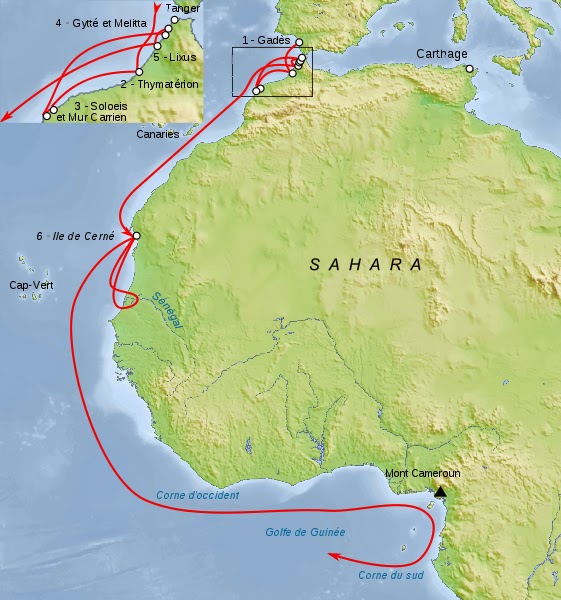 Generally, it is agreed that Hanno established seven colonies along the Moroccan coast. The last colony was on the island of Herne. Sailing south of there was where his adventure into totally unexplored territory commenced. Probably on the Senegal River, he encounters savage tribes, a burning mountain that was probably Mt. Cameroon, and hairy man-like creatures. These dark hairy men scattered into the hills, but he managed to capture three women and promptly flayed them and brought the skins back to Carthage. He called them gorillae and this is were our name for gorillas originated.
A translation of Hanno’s account is below and you can also follow the link to a website that analyzes the adventure in detail. http://www.metrum.org/mapping/hanno.htm
It was decreed by the Carthaginians, that Hanno should undertake a voyage beyond the Pillars of Hercules, and found Liby-Phoenician cities. He sailed accordingly with sixty ships of fifty oars each, and a body of men and women to the number of thirty thousand, and provisions and other necessaries
When we had passed the Pillars on our voyage, and had sailed beyond them for two days, we founded the first city which we named Thymiaterius]. Below it lay an extensive plain. Proceeding thence towards the west, we came to Soloeis, a promontory of Libya, a place thickly covered with trees, where we erected a temple to Neptune; and again proceeded for the space of half a day towards the east, until we arrived at a lake lying not far from the sea. and filled with abundance of large reeds. Here elephants, and a great number of other wild beasts, were feeding.
Having passed the lake about a day s sail, we founded cities near the sea, called Cariconticos, and Gytte, and Acra, and Melitta, and Arambys.Thence we came to the great river Lixus, which flows from Libya. On its banks the Lixitae, a shepherd tribe, were feeding flocks, amongst whom we continued some time on friendly terms. Beyond the Lixitae dwelt the inhospitable Ethiopians, who pasture a wild country intersected by large mountains, from which they say the river Lixus flows. In the neighbourhood of the mountains lived the Troglodytae, men of various appearances, whom the Lixitae described as swifter in running than horses.
Having procured interpreters from them, we coasted along a desert country towards the south two days. Thence we proceeded towards the east the course of a day. Here we found in a recess of a certain bay a small island, containing a circle of five stadia, where we settled a colony, and called it Cerne. We judged from our voyage that this place lay in a direct line with Carthage; for the length of our voyage from Carthage to the Pillars, was equal to that from the Pillars to Cerne.
We then came to a lake, which we reacted by sailing up a large river called Chretes This lake had three islands, larger than Cerne from which proceeding a day's sail, we came to the extremity of the lake, that was overhung by large mountains, inhabited by savage men clothed in skins of wild beasts, who drove us away by throwing stones, and hindered us from landing. Sailing thence we came to another river, that was large and broad, and full of crocodiles, and river horse]; whence returning back we came again to Cerne
Thence we sailed towards the south twelve days, coasting the shore, the whole of which is inhabited by Ethiopians, who would not wait our approach, but fled from us. Their language was not intelligible even to the Lixitae who were with us. Towards the last day we approached some large mountains covered with trees, the wood of which was sweet-scented and variegated. Having sailed by these mountains for two days, we came to an immense opening of the sea; on each side of which, towards the continent, was a plain; from which we saw by night fire arising at intervals in all directions, either more or less.
Having taken in water there, we sailed forwards five days near the land, until we came to a large bay, which our interpreters informed us was called the Western Horn. In this was a large island, and in the island a saltwater lake, and in this another island, where, when we had landed, we could discover nothing in the daytime except trees; but in the night we saw many fires burning, and heard the sound of pipes, cymbals, drums, and confused shouts. We were then afraid, and our diviners ordered us to abandon the island. Sailing quickly away thence we passed a country burning with fires and perfumes; and streams of fire supplied from it fell into the sea. The country was impassable on account of the heat. We sailed quickly thence, being much terrified; and passing on for four days, we discovered at night a country full of fire. In the middle was a lofty fire, larger than the rest, which seemed to touch the stars. When day came we discovered it to be a large hill, called the Chariot of the Gods. On the third day after our departure thence, having sailed by those streams of fire, we arrived at a bay called the Southern Horn[11]; at the bottom of which lay an island like the former, having a lake, and in this lake another island, full of savage people, the greater part of whom were women, whose bodies were hairy, and whom our interpreters called Gorillae. Though we pursued the men we could not seize any of them; but all fled from us, escaping over the precipices, and defending themselves with stones. Three women were however taken; but they attacked their conductors with their teeth and hands, and could not be prevailed upon to accompany us. Having killed them, we flayed them, and brought their skins with us to Carthage. We did not sail farther on, our provisions failing us.
8/09/2013
The Saga of Chief Hole in the Day
 |
| Chief Hole in the Day |
 |
| Minnesota Reservations |
 |
| Sunset on Leech Lake, MN |
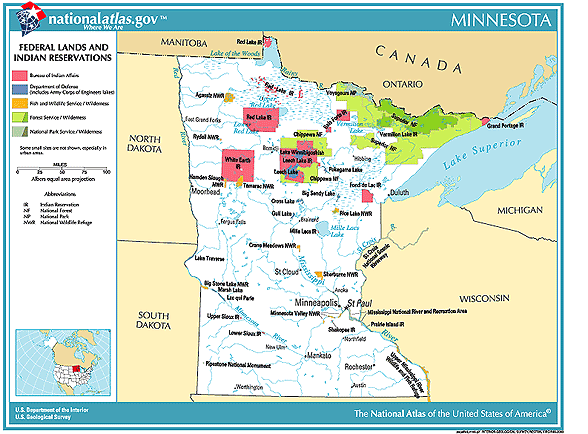
Five months later on September 5,1898, they attempted to seize the chief again. This time he managed to escape and fled to his home at Sugar Point, a small peninsula in the northeast corner of the expansive Leech Lake. The U.S. Indian Agent, Arthur Tinker requested aid from Fort Snelling and twenty regular army troops were dispatched to the reservation. When Hole in the Day refused to surrender, seventy-seven additional troops, commanded by Brevet Major Melville C. Wilkinson were sent as reinforcements. With larger numbers, the army invaded Sugar Point, but was unable to find the chief, who apparently fled. Soldiers began searching the surrounding woods and neighboring villages to arrest any tribesmen with outstanding warrants. Finding only a few old men, women, and children, they noted it was strange there were no young, able men in the area.
Who fired the first shot is still in dispute. According in one account a soldier’s rifle accidentally discharged and was answered by gunfire from Indians hiding in the forest. Indian accounts say soldiers fired at a canoe on Leech Lake carrying several women. Regardless of how it started, gunfire from the woods surrounding Sandy Point erupted around 11:30 am. The soldiers could only hunker down and retreat to a lakeside cabin for cover. Major Wilkinson lost several men and was wounded in the leg. He took another bullet to his abdomen at the cabin and died shortly after. Gunfire slowly decreased as evening fell. By morning the Indians seemed to have dispersed, but took one more life when a soldier was killed trying to dig up potatoes from a garden.
The soldiers, devastated by a mere force of eighteen Indians, marched to Walker, Minnesota with seven dead, and fourteen wounded. Not one Pillager was killed or wounded (on record). Chief Hole in the Day was never captured. The skirmish raised fears of an uprising. Minnesota’s National Guard was mobilized in response, but the Indians dispersed into the deep forests of northern Minnesota. The day after the battle, the Cass County Pioneer newspaper published this letter received from the chiefs of the Pillager Band.
“We, the undersigned chiefs and headmen of the Pillager Band of Chippewa Indians of Minnesota …respectfully represent that our people are carrying a heavy burden, and in order that they may not be crushed by it, we humbly petition you to send a commission, consisting of men who are honest and cannot be controlled by lumbermen, to investigate the existing troubles here… We now have only the pinelands of our reservation for our future subsistence and support, but the manner in which we are being defrauded out of these has alarmed us. The lands are now, as hereto fore, being underestimated by the appraisers, the pine thereon is being destroyed by fires in order to create the class of timber known as dead or down timber, so as to enable others to cut and sell the same for their own benefit.”
Several days after the incident the U.S. Commissioner of Indian Affairs, William A. Jones negotiated with the Pillager leaders at a tribal council. Afterward he criticized local officials for “frequent arrests for trivial causes, often for no cause at all, and taking them to Duluth or Minneapolis for trials, two hundred miles away from their agency.” I cannot help but think that this well-written, civilized, logical letter sent to the Cass County Pioneer newspaper helped defuse the issue. Still, there is a note of humility and sadness in the letter that moved me.
7/04/2013
Gundestrup Cauldron

One of the things about traveling I like the most is running into something wonderful and unexpected. This was the case in Copenhagen. On the way back to the hotel we stumbled on to the Copenhagen National Museum. Jan pulled out a guidebook and next to the information about the museum was picture of the Gundestrup Cauldron. The Cauldron is a masterwork, iconic of La Tene, Celtic culture. It or some part of it appears in literally every publication referencing Celtic art, history, and mythology. It has been used on the cover of 100's of journals and books. It was something that I had to see.

The great cauldron did not disappoint with this caveat: the cauldron, which has become symbolic of Celtic culture, is an enigma, because its true origin and purpose are unknown. In 1891 the priceless silver artifact was discovered while digging for peat in the Raevemosen Bog in Himmerland, Juteland. The cauldron was dropped into the bog—perhaps as a valuable sacrifice to the gods sometime between 200 BC and 300 AD. which is a very broad range. The images depicted on it come far away from the northerly realm where it was found. Elephants, lions and several gods represented in a foreign style indicate that the cauldron had its origin in remote areas south or southeast of Juteland. Exactly where it was made or how it got to Juteland is unknown. It could have been commissioned, traded, or stolen. But surely it was the prize possession of a great chieftain or priest and used for ritual drinking and feasts.
Most researchers agree that the vessel portrays elements of La Tene workmanship and that is why it is used in most books and articles that reference ancient Celtic culture and art. I am not the expert, but it seems to lack the spirals, curves and entwined art elements that signify La Tene motifs. The predominent heads on the sides of the cauldron seem very classical. A plaque on the exhibit stated that the technology to produce it did not exist in northern Europe or Gaul during the range of time it was created and suggested it may have been produced in Thrace where working with silver flourished.
The relic is a good example of the elusiveness of pinning down a definition of Celtic Culture. Still, it is one of the most remarkable artifacts I have ever seen, dazzling and spellbinding. Filled with potent drink, it would be a “goldmine” of inspiration for any ancient chieftain or even a golf buddy.
4/11/2013
Postmarked June 29, 3123 BC

Recently I caught a glimpse of a program on the History Channel about a clay tablet carved in Nineveh, the ancient capital of Babylon, circa 700 BC. The tablet was professed to have recorded the exact date of the Sodom and Gomorrah apocalypse. They called it the “Sumerian Planisphere”. A planisphere is a small round disk astronomers use to create a map of the heavens. Backyard astronomers still use them today, but instead of carving them in clay, they are made of printed paper or plastic disks which they rotate to create a map of the nighttime sky at any date or time.
Even more intriguing is that part of the inscription mentions this tablet was copied from a tablet made 2000 years earlier. This puts the original tablet at about 3000 BC and the phenomena it recorded occurring, literally, at the dawn of civilization. An event of such magnitude, the ancient people of Mesopotamia inscribed it in clay, copied it, and passed down from generation to generation.
The artifact was excavated at Nineveh in 1912 by Henry Layard. He cataloged it #K8538 and placed it in the British Museum to rest among the host of famous Assyrian artifacts such as the huge winged lions that guarded the gates of Nineveh. Parts of the tablet were translated but many aspects were not understood. Positions of stars and constellations were easy to understand, like the position of Orion, Scorpio, Polaris, and even the Milky Way. Other references like “The white bowl approaching. Vigorously swept along.” were far more ambiguous and created more questions than answers. The object sat inconspicuously, without further attention until 2008 when Alan Bond and Mark Hempsell* completely deciphered the tablet and used astronomical software to trace the positions of the objects it depicted back through time and correlated them with the exact date of June 29, 3123 BC.
Bond and Hemspell found the tablet precisely plotted the position of an object, moving across the sky and the trajectory and date of the object coincided with an asteroid collision into the Alps near Kofels, Switzerland.

The low trajectory of the asteroid caused it to vaporize in the atmosphere, just prior to impact so no crater resulted, but millions of tons of debris flowed down the mountain in a gigantic landslide. Hempspell claims that a mushroom-like plume would have risen hundreds of miles into the air and drifted backwards over the Egypt, Asia Minor and the Sinai Peninsula causing mass destruction, raining down fiery rocks, and spontaneously igniting flammable materials on the ground where temperatures exceeded 700 degrees F. This is the type of catastrophe that could result in the complete destruction of several cities, hence the inference to Sodom and Gomorrah.
Whether this event was responsible for the demise of Sodom and Gomorrah is questionable. Still, myths abound about fiery destruction. Bond and Hempspell have identified twenty. Sodom and Gomorrah is only one story. Another is the Greek myth of Phaeton. Phaeton was the son of Helios, the sun god and when allowed to drive his father’s sunny chariot across the sky, but he could not control it. Flying too close to the earth, he scorched the earth and Zeus struck him down with a lightning bolt before he destroyed all of humankind.
To me whether or not the asteroid plotted on the tablet caused the end of Sodom and Gomorrah is not important. The thrill is that the tablet accurately records the path of an asteroid, flying across the heavens over 5,000 years ago, when the written word was first starting to emerge, when bronze was first hammered, and when the first walled cities were being built. The ancients not only recorded the event, but passed the knowledge down from generation to generation, across kingdoms, cultures, and empires, and now it is part of the modern historical record, a postcard postmarked June 29, 3123 BC.
1.Sumerian Observation of the Kofels Event, Bond and Hempspell, 2008
3/05/2013
A Post Card from Pompeii
Nothing sends a stronger message than a written message from an eyewitness of an event, freezing the moment in time. Pliny the Younger did just that with two letters documenting the eruption of Mt. Vesuvius in 79 AD.
 Typically, archaeologists excavate tombs of the important people, rulers with god-like status, and all the wealth in the world (literally). Cities, more often than not, are the remains of ruins already destroyed by conquering invaders or ravaged by erosion for eons of time. Human remains are limited to piles of bones at the bottom of graves or in sarcophaguses pillaged by grave robbers thousands of years prior to the excavation. Once in a great while, a find is made, like Pompeii, where the city is preserved, buried beneath twenty feet of ash in a matter of days, and then forgotten for 1500 years. Sealed in its tomb, it was undisturbed until 1599 by an Italian architect, who after uncovering a fresco, decided to rebury it, because of its lewd offensive nature. In 1748 during the excavation of Pompeii’s sister city, Herculaneum , Pompeii was officially rediscovered. Because it was sealed so completely, beautiful frescos, statues, villas, and temples were preserved in remarkable condition. Vesuvius was not selective in who it buried, so common people, wealthy merchants, and slaves all died together. Many left impressions, hollow cavities under the ash from which grotesque, plaster replicas could be cast, revealing their horrific final moments.
  |
| Add caption |
Pompeii was a thriving seaport on the Adriatic that funneled goods into Rome. Of course today the ruins are seven miles from the sea, which has receded. I remember our tour guide claiming the city had a population exceeding 40,000. That would be twice the size of renaissance Venice. You would wonder how a city of this size could be lost so close to the modern era and I have never heard a reasonable explanation. Particularly with an eyewitness account of the disaster surviving in the writings of Tacitus. I can only suppose that scholars, reading the letters, assumed that the city existed, but was hopelessly lost to the world.

This first letter was in response to Tacitus’ inquiry regarding Pliny the Elder’s death
"My uncle was stationed at Misenum, in active command of the fleet. On 24 August, in the early afternoon, my mother drew his attention to a cloud of unusual size and appearance. He had been out in the sun, had taken a cold bath, and lunched while lying down, and was then working at his books. He called for his shoes and climbed up to a place which would give him the best view of the phenomenon. It was not clear at that distance from which mountain the cloud was rising (it was afterwards known to be Vesuvius); its general appearance can best be expressed as being like an umbrella pine, for it rose to a great height on a sort of trunk and then split off into branches, I imagine because it was thrust upwards by the first blast and then left unsupported as the pressure subsided, or else it was borne down by its own weight so that it spread out and gradually dispersed. In places it looked white, elsewhere blotched and dirty, according to the amount of soil and ashes it carried with it.
My uncle's scholarly acumen saw at once that it was important enough for a closer inspection, and he ordered a boat to be made ready, telling me I could come with him if I wished. I replied that I preferred to go on with my studies, and as it happened he had himself given me some writing to do.
As he was leaving the house he was handed a message from Rectina, wife of Tascus whose house was at the foot of the mountain, so that escape was impossible except by boat. She was terrified by the danger threatening her and implored him to rescue her from her fate. He changed his plans, and what he had begun in a spirit of inquiry he completed as a hero. He gave orders for the warships to be launched and went on board himself with the intention of bringing help to many more people besides Rectina, for this lovely stretch of coast was thickly populated.
He hurried to the place which everyone else was hastily leaving, steering his course straight for the danger zone. He was entirely fearless, describing each new movement and phase of the portent to be noted down exactly as he observed them. Ashes were already falling, hotter and thicker as the ships drew near, followed by bits of pumice and blackened stones, charred and cracked by the flames: then suddenly they were in shallow water, and the shore was blocked by the debris from the mountain.
For a moment my uncle wondered whether to turn back, but when the helmsman advised this he refused, telling him that Fortune stood by the courageous and they must make for Pomponianus at Stabiae. He was cut off there by the breadth of the bay (for the shore gradually curves round a basin filled by the sea) so that he was not as yet in danger, though it was clear that this would come nearer as it spread. Pomponianus had therefore already put his belongings on board ship, intending to escape if the contrary wind fell. This wind was of course full in my uncle's favour, and he was able to bring his ship in. He embraced his terrified friend, cheered and encouraged him, and thinking he could calm his fears by showing his own composure, gave orders that he was to be carried to the bathroom. After his bath he lay down and dined; he was quite cheerful, or at any rate he pretended he was, which was no less courageous.
Meanwhile on Mount Vesuvius broad sheets of fire and leaping flames blazed at several points, their bright glare emphasized by the darkness of night. My uncle tried to allay the fears of his companions by repeatedly declaring that these were nothing but bonfires left by the peasants in their terror, or else empty houses on fire in the districts they had abandoned. Then he went to rest and certainly slept, for as he was a stout man his breathing was rather loud and heavy and could be heard by people coming and going outside his door. By this time the courtyard giving access to his room was full of ashes mixed with pumice stones, so that its level had risen, and if he had stayed in the room any longer he would never have got out. He was wakened, came out and joined Pomponianus and the rest of the household who had sat up all night.
They debated whether to stay indoors or take their chance in the open, for the buildings were now shaking with violent shocks, and seemed to be swaying to and fro as if they were torn from their foundations. Outside, on the other hand, there was the danger of failing pumice stones, even though these were light and porous; however, after comparing the risks they chose the latter. In my uncle's case one reason outweighed the other, but for the others it was a choice of fears. As a protection against falling objects they put pillows on their heads tied down with cloths.
Elsewhere there was daylight by this time, but they were still in darkness, blacker and denser than any ordinary night, which they relieved by lighting torches and various kinds of lamp. My uncle decided to go down to the shore and investigate on the spot the possibility of any escape by sea, but he found the waves still wild and dangerous. A sheet was spread on the ground for him to lie down, and he repeatedly asked for cold water to drink.
Then the flames and smell of sulphur which gave warning of the approaching fire drove the others to take flight and roused him to stand up. He stood leaning on two slaves and then suddenly collapsed, I imagine because the dense, fumes choked his breathing by blocking his windpipe which was constitutionally weak and narrow and often inflamed. When daylight returned on the 26th - two days after the last day he had been seen - his body was found intact and uninjured, still fully clothed and looking more like sleep than death."
Passages from his second letter following up on the escape of himself and his mother.
"...Ashes were already falling, not as yet very thickly. I looked round: a dense black cloud was coming up behind us, spreading over the earth like a flood.'Let us leave the road while we can still see,'I said,'or we shall be knocked down and trampled underfoot in the dark by the crowd behind.'We had scarcely sat down to rest when darkness fell, not the dark of a moonless or cloudy night, but as if the lamp had been put out in a closed room.
You could hear the shrieks of women, the wailing of infants, and the shouting of men; some were calling their parents, others their children or their wives, trying to recognize them by their voices. People bewailed their own fate or that of their relatives, and there were some who prayed for death in their terror of dying. Many besought the aid of the gods, but still more imagined there were no gods left, and that the universe was plunged into eternal darkness for evermore.
There were people, too, who added to the real perils by inventing fictitious dangers: some reported that part of Misenum had collapsed or another part was on fire, and though their tales were false they found others to believe them. A gleam of light returned, but we took this to be a warning of the approaching flames rather than daylight. However, the flames remained some distance off; then darkness came on once more and ashes began to fall again, this time in heavy showers. We rose from time to time and shook them off, otherwise we should have been buried and crushed beneath their weight. I could boast that not a groan or cry of fear escaped me in these perils, but I admit that I derived some poor consolation in my mortal lot from the belief that the whole world was dying with me and I with it."
References:
Allen, G.B. (editor), Selected Letters of Pliny, (1915); Maiuri, Amedeo,
1/17/2013
Syracusia - Titanic Luxury Liner of Ancient World
The novel I am currently working on is set in the in the ancient Mediterranean circa 480 BCE. This is the time when Xerxes sent his great army to Thermopylae and the meager band of Spartans made their stand against his minions. After the battle, Xerxes turned his attention to Athens and sent his fleet around the Grecian peninsula to land troops and secure his position. It was there, in the straits of Salamis, a confederation of Greek warships destroyed his navy and forced him to abandon his dream of conquest.
 When I began researching the ships of the time, I expected to find crude wooden craft tied together with ropes, capable of limited voyages, island to island across the Mediterranean, and Aegean. What I did not realize, was Phoenicians, Minoans, Greeks, Carthaginians, and Egyptians were sailing across the Mediterranean in sophisticated vessels for over a thousand years before Xerxes attempted his conquest of Greece.
By 480 BCE warships had evolved into sleek war machines, carrying about two hundred crewmen, three levels or oars, and armed with heavy bronze rams mounted on the bows to ram enemy ships. This is what is commonly depicted on TV and in movies. To my surprise commercial shipping was an entirely different matter. Huge ships with several masts, capable of carrying thousands of tons of cargo and hundreds of passengers were widely used. The Titanic of these ships was the Syracusia. This ship was a monstrous luxury liner comparable with cruise ships bobbing across the seas today.

Designed by Archimedes, the famous engineer, Syracusia was built on the island of Sicily in 240 BCE on and order from Hieron II. Hieron II was the current tyrant of the major city-state, Syracuse. The ship was 360 feet long and 80 feet wide. To fathom this, consider a football field, which is 300 feet long. Syracusia carried 1,943 passengers who slept in staterooms, just like the smaller luxury liners that cruise the Mediterranean today. Similarities do not stop there. This ship also featured a hot water pool, garden promenade, library, restaurant, and temple dedicated to Aphrodite. Marble statues and carved ivory lavishly decorated these features.
Piracy was a major problem (as it is even today) and the Syracusia carried 200 armed soldiers, two large catapults and three(or more) protective towers rose above the deck manned by archers.
Materials to construct the vessel came from all over the world. The hull was made of pine from the slopes of Mount Etna, cord from Spain, pitch, and hemp from France. All this was nailed together with imported copper spikes, a testament to the vastness of trade and shipping that existed by this era. Her maiden voyage was to Alexandria in Egypt and she carried 60,000 measures of grain, 10,000 jars of pickled fish, and 20,000 talents of wool. This adds up to approximately 2000 tons of cargo.
Whenever I look in the past, I am always amazed to find out how much more advanced and how much we have in common with so called ancient cultures. What I would give for a Mediterranean cruise on this luxury liner.
To learn about this marvelous ship and ancient sailing, Lionel Classon is he reputed expert with several works available.
To learn about this marvelous ship and ancient sailing, Lionel Classon is he reputed expert with several works available.
12/08/2012
Diogenes: Homeless, but not Hapless

It turned out that the man, who received the new shoes from the officer, was indigent, but not really homeless, and he sold the shoes for hard cash. People ask, “How could he do that? or What kind of hopeless nut job is he?” We cannot seem to fathom the idea that some people do not care about material things, or conventional customs, and assume they must be lazy or mentally ill to display such behavior.
This is not a new manifestation of the twentieth century. Diogenes of Sinope (412-323BC), the renowned Greek philosopher is an example of a very early unsociable homeless person. I am not saying our homeless are great philosophers, but they are not all drug addicts, criminals, or shiftless no accounts either. Diogenes renounced all material things and slept in a large earthen jar in the agora.
Diogenes was asked, "Tell me, to what do you attribute your great poverty?"
"Hard work," he replied.
"And what advice can you offer the rich?"
"Avoid all the good things in life."
"Why?"
"Because money costs too much. A rich man is far poorer than a poor man."
"How can that be?"
"Because poverty is the only thing money can't buy."

A favorite story is that Alexander the Great sought him out and found him enjoying the sun in the market place. He offered to give Diogenes anything in the world he wanted. Diogenes said, “Yes—there is something—could you move out of my sun.
or
Diogenes was knee deep in a stream washing vegetables. Coming up to him, Plato said, "My good Diogenes, if you knew how to pay court to kings, you wouldn't have to wash vegetables."
"And," replied Diogenes, "If you knew how to wash vegetables, you wouldn't have to pay court to kings."
His behavior was psychotic by today’s standards. There is even a malady called Diongenes Syndrome. In his own time, he was spat on by the citizens of Athens and Corinth, and demeaned and laughed at by esteemed men like Plato and Socrates. As despicable as Diogenes was, he had a following of disciples, men who listened to him and wrote down his anecdotes and wisdoms. He did not write down anything himself, but many of his wisdoms and anecdotes have survived through the ages.
A young man contemplating marriage sought advice from Diogene:
"Should I marry?"he asked.
"Marriage is too soon for a young man"
"Would you have me wait then until I am old."
"Oh no, Marriage is far too late for an old man."
"What am I to do then? I love the girl."
"Love is a luxury no one can afford. It is for those who have nothing better to do."
"What should we be doing then?"
"To seek freedom. But it is not possible to be free if you have a wife and children."
"But having a wife and family is so agreeable."
"Then you see the problem, young man. Freedom would not be so difficult to attain were prison not so sweet."
"You mean to be free is to be alone?"
"We come into the world alone and we die alone. Why, in life, should we be any less alone?"
"To live, then, is terrible."
"No, not to live, but to live in chains."
Call me a democrat, but it does not irk me to provide a homeless person with a dry place to sleep, warm blanket, and hot meal with no strings or drug testing attached.
"Why is it, Diogenes, that pupils leave you to go to other teachers, but rarely do they leave them to come to you?"
"Because," replied Diogenes, "one can make eunuchs out of men, but no one can make a man out of eunuchs".
Subscribe to:
Posts (Atom)